Frequently Asked Questions
Discovery Flights
Do I need a reservation?
Yes, all flights are done by reservation only. Please call or email us to check availability.
What should I wear?
A T-shirt and shorts will be fine when it's warm and in the cooler months we recommend a long sleeve shirt and pants. A light jacket is also good idea in the winter months. We also have jackets and gloves for you to use during the flight if you forget to bring your own. Remember: we are flying a few thousand feet above the ground and it's usually a little cooler up there!
How long will the flight last?
On average, our 2,000 foot Discovery Flight lasts 10 to 12 minutes. Our 3,500 foot Discovery Flight lasts about 15-20 minutes, and the Mile High Discovery Flight reaches 5,280 feet above the ground and lasts about 30-35 minutes.
Do I need any experience?
Since your first flights are with a tandem instructor, you do not need any previous experience to enjoy a hang gliding flight. You will be able to take the controls and learn what it takes to fly the hang glider, or you can let the instructor do most of the work and simply hang out and enjoy the flight.
How does the glider take off?
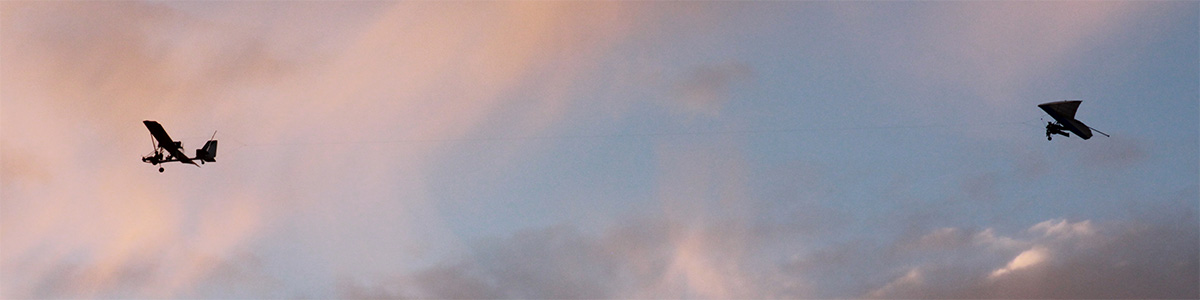
First, you are securely hooked into a harness hanging from our tandem hang glider with your instructor hanging just below you. The glider is temporarily attached by a tow rope to a special airplane designed just to tow hang gliders. The airplane tows the glider up similar to how a boat tows a water skier. The glider is equipped with wheels, so it rolls down the runway before lifting off. The entire launch process is effortless for the student, allowing you to relax and enjoy the view.
How does the glider land?
After the glider releases from the tow plane, it is guided by the instructor to fly back down and land near where it took off. We land back on the fixed landing gear and there is never any need to run or even stand up. Tandem hang gliding is great for people of different physical abilities.
What age must you be to fly?
Because we take off and land on wheels, we can take a wide range of ages and people of all physical abilities. We've taken folks as young as 10 and as old as 90. The main determining factors are the person's size and ability to follow directions in flight.
Flight Training
How long does it take to learn?
Flying a hang glider can take as little as a few weeks or months to learn, but can take decades or a lifetime to master. Hang Glide Wisconsin primarily uses the aerotow training method which is the most safe and efficient way to learn how to hang glide. During the training flights, you have an instructor by your side guiding you along the way. Over time, pilots learn to fly in more challenging conditions and eventually how to soar like the birds: staying up in the sky using the natural power of thermals.
What is USHPA?
USHPA stands for the United States Hang Gliding and Paragliding Association. USHPA is our national organization that provides advocacy for our sport and preserves our flying sites. You must be a USHPA rated pilot to fly at Sonora Wings and most good flying sites across the country. A temporary 30 day USHPA membership will be issued to all new pilots on the day of your first flight, and you will receive information about how to purchase a full membership. You can read more about USHPA on their website at ushpa.aero.
How safe is flying a hang glider?
All of the Discovery Flights at Sonora Wings are done "tandem", with 2 people: you (the student) along with an instructor. Flying with a tandem instructor is the safest way you can experience hang gliding. Sonora Wings' instructors will use their skills and expertise to make sure you always have a safe and enjoyable experience. Tens of thousands of safe tandem hang gliding flights happen all over the country every year. Sonora Wings uses the most proven, reliable, and modern methods and equipment used in the sport.
If you are taking lessons at Sonora Wings, your instructor will be there for you at every step, guiding you along the way, and keeping you safe as you progress through training. Compared to traditional hang gliding training methods, tandem aerotow flight training is the safer and quicker way to learn how to hang glide.
How much does equipment cost?
Sonora Wings rents training gliders and equipment for all of your training. Typically after pilots have flown solo, and begin flying on their own at different flying sites, they choose to buy their own equipment. At the minimum, the items needed to fly on your own consist of a hang glider wing, harness, safety parachute, and helmet. Most people also buy an electronic vario and a few other small accessories. The general price range for everything you need is $5,000-$6,000 for brand new, modern, hang gliding equipment. For pilots on a tighter budget, Sonora Wings also has a good inventory of used equipment and you can get everything you need to fly for as little as $2,000-$4,000. Hang Glide Wisconsin is a dealer of Wills Wing, Moyes, High Energy Sports, Flytec, and Rotor.
What about foot launching?
At Hang Glide Wisconsin we use a building block method of training. You start with tandem aerotow flights: taking off and landing on wheels with an instructor by your side. After you begin flying solo, you work up to landing on your feet. Then, when you finally know how to fly on your own and land on your feet, we go to the training hill where you learn to launch by simply running off the hill.
This building block method of instruction is safe, efficient, and is becoming the most common method of hang glider training.